What Are Industrial Automation Systems?
Industrial automation systems connect machines, sensors, software, and people to control industrial processes. A production line may use sensors to detect a misplaced part, a programmable controller to stop a conveyor, and a robot to reposition the component. The system’s purpose is not simply to replace manual work. It can also improve repeatability, traceability, and process visibility. In practice, these benefits depend on good integration, maintenance, and operator training. The hardware alone is not the whole story.
The scale is significant. The International Federation of Robotics reported 4,281,585 industrial robots operating in factories worldwide in 2023, a 10% increase from 2022. Its World Robotics 2024 report also recorded 541,302 new robot installations that year. Those figures describe robots, not every kind of automation, so they should not be mistaken for a complete measure of industrial automation systems. Deloitte’s 2024 Smart Manufacturing and Operations Survey likewise examines manufacturers’ investment priorities and expected operational gains, adding context beyond robot counts. Still, forecasts and survey responses are not guaranteed results. A factory floor is less tidy than a chart suggests: legacy equipment, unexpected downtime, and uneven data quality can complicate deployment. Understanding the system’s components and limits helps explain where automation creates value—and where careful human judgment remains essential.
Definition and Scope of Industrial Automation Systems
What Are Industrial Automation Systems?
Definition and Scope of Industrial Automation Systems
Industrial automation systems coordinate machines, controls, software, and people to carry out production tasks with limited manual intervention. They may regulate temperature, move materials, fill containers, or check product dimensions. Their purpose is not simply to replace workers. They help make processes more consistent, visible, and controllable.
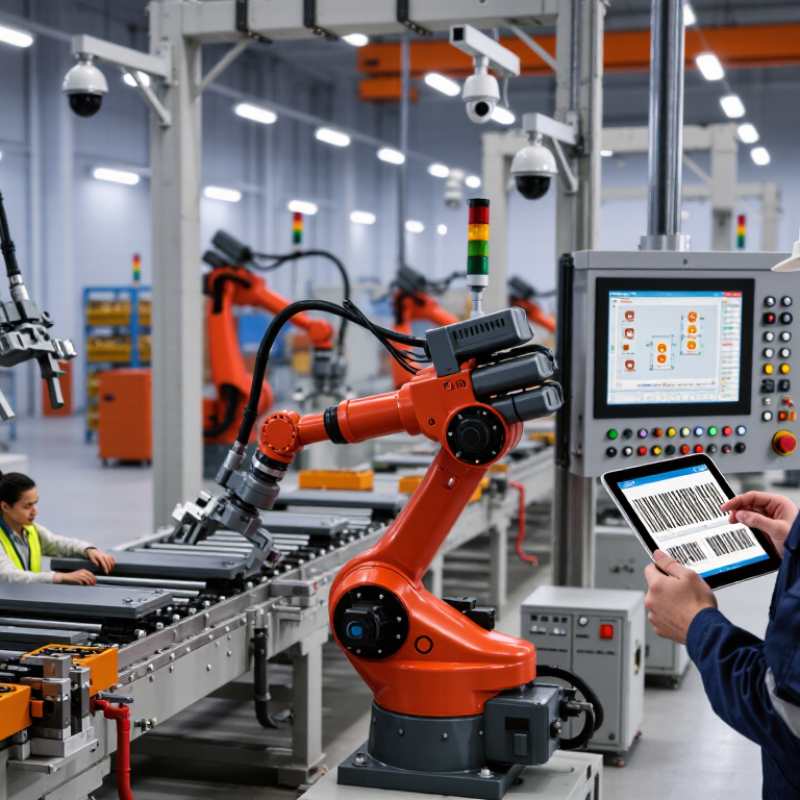
A typical system can include sensors, programmable controllers, motors, drives, robots, operator panels, and supervisory software. A sensor might detect a bottle beneath a filling nozzle; a controller then signals a valve to open for a set interval.
Not just machines.
The scope also covers communication networks, safety functions, process data, and the procedures operators use to respond to alarms. Even a small packaging cell depends on these parts working together.
The boundary can be messy. A production line may connect to inventory software, maintenance records, or quality systems, though those tools are not always considered part of automation itself. Scope depends on the process and on who maintains each connection. Reliable design considers what happens during a jam, sensor fault, or network interruption—not only when everything runs smoothly. Operators need clear displays and practical ways to intervene. These details are easy to overlook during planning.
Core Components and Technologies
An industrial automation system connects sensing, decision-making, and physical action on a production line. Sensors measure temperature, pressure, position, or vibration; actuators turn commands into movement. A programmable logic controller (PLC) runs repeatable control logic. Supervisory control and data acquisition (SCADA) software gives operators a wider view. Human-machine interfaces (HMIs), industrial networks, drives, and safety circuits complete the practical stack. Small details matter.
Factories worldwide had 4.28 million industrial robots in operation in 2023, according to the International Federation of Robotics’ World Robotics 2024 report. Automation is not just robotics. Networks move data between controllers, sensors, and production software; cybersecurity and careful calibration help keep that data useful. Deloitte’s 2024 Smart Manufacturing and Operations Survey found that 86% of respondents viewed smart manufacturing as a key competitiveness driver over the next five years. That is a survey finding, not a guaranteed result. Real plants still face old equipment, noisy readings, and awkward handoffs. Some fixes look less elegant than the diagrams.
Tips: Map one process before buying equipment. Check sensor accuracy and network delays under real operating conditions. Keep manual recovery steps clear; automation can fail in ordinary, frustrating ways.
How Industrial Automation Systems Operate
What Are Industrial Automation Systems?
How Industrial Automation Systems Operate
An industrial automation system turns measurements into controlled action. Sensors monitor conditions such as temperature, pressure, position, or speed. A controller compares these readings with target values, then signals motors, valves, or robotic arms. On a conveyor, a photoelectric sensor can detect a passing carton and trigger a diverter. The controller also checks whether the expected movement occurred. That feedback helps it adjust the process or stop equipment when readings fall outside safe limits. Operators use interface screens to view alarms, production counts, and machine status.
Simple in concept. Exacting in practice.
The International Federation of Robotics’ World Robotics 2024 report counted 4,281,585 industrial robots operating worldwide in 2023, with 541,302 installed that year. Those figures show the scale of automated production, but robots are only one part of the operating system. Controllers, sensors, networks, and safety devices must work together, often within fractions of a second. A misaligned sensor can still produce a confident-looking number. That is why teams check calibration, review alarm histories, and test shutdown responses during maintenance. Network connections can also delay or interrupt signals, so critical equipment needs clear fault responses. Automation reduces repetitive work, but it does not remove human judgment.
A missed warning still matters.
Major Types of Automation Systems
Industrial automation systems are commonly classified by how easily equipment can change tasks. Fixed automation performs one stable operation at high volume, such as a dedicated line stamping identical metal parts. It can be fast and consistent. But changeovers may be costly.
Programmable automation handles batches through changed instructions and tooling. A packaging cell, for example, can switch between product sizes after an operator updates its settings. Flexible automation goes further, allowing quicker changes across different jobs, often with robotic equipment and sensors. The boundary is not always clear: a line may seem flexible, yet still need lengthy setup work.
Integrated automation connects machines, controllers, and production data into a coordinated process. It can help teams spot delays between a conveyor, inspection station, and packing area. The International Federation of Robotics reported 541,302 industrial robot installations in 2023, following 553,052 in 2022, in its World Robotics 2024 and 2023 reports. Those figures show the scale of industrial robotics, not the share of each automation type. Choosing a system still depends on product variety, output targets, and changeover time. Real plants are often messier than neat categories suggest.
What Are Industrial Automation Systems? - Major Types of Automation Systems
| Automation System Type |
How It Works |
Production Volume and Variety |
Typical Equipment |
Common Applications |
Key Consideration |
| Fixed (Hard) Automation |
Uses dedicated equipment and a preset sequence of operations to produce the same item repeatedly. |
Very high production volume; low product variety. |
Transfer lines, dedicated assembly machines, and specialized material-handling equipment. |
High-volume assembly, bottling, and continuous processing. |
Offers fast, consistent output, but changing the product or process can require substantial equipment modifications. |
| Programmable Automation |
Equipment follows instructions that can be changed by reprogramming or reconfiguring the production sequence. |
Low-to-medium production volume; products are commonly made in batches. |
Numerically controlled machine tools, industrial robots, and programmable logic controllers. |
Batch machining, metal fabrication, and production of multiple product variants. |
Supports product changes, but switching between batches may require setup time and reprogramming. |
| Flexible (Soft) Automation |
Uses computer-controlled equipment and automated material handling to switch between products with little or no manual changeover. |
Medium production volume; moderate-to-high product variety. |
Flexible manufacturing cells, computer-controlled machines, and automated storage and handling systems. |
Mixed-model machining and manufacturing where product types change frequently. |
Enables quick changeovers, but system integration and equipment investment can be substantial. |
| Integrated Automation |
Connects machines, controls, production data, and supervisory systems to coordinate operations across a process or facility. |
Varies by installation; often used to coordinate complex or large-scale production. |
Industrial control systems, sensors, supervisory software, networks, and manufacturing execution systems. |
Process plants, coordinated production lines, and facilities requiring centralized monitoring. |
Can improve visibility and coordination, while requiring careful integration, cybersecurity, and maintenance planning. |
Industrial Applications and Key Benefits
Industrial automation systems use sensors, controllers, software, and machines to monitor or perform production tasks. Their applications vary by industry. On a packaging line, photoelectric sensors detect cartons while programmable controllers coordinate conveyors and filling equipment. In food processing, temperature sensors can flag a cooling process that drifts outside its target range. Water treatment facilities use automated controls to track flow and adjust pumps as demand changes.
The benefits are practical and measurable. Consistent machine settings can reduce variation between batches, while automated inspection can identify defects before products leave the line. Operators may also receive alerts about rising motor temperatures or unusual vibration, giving maintenance teams time to investigate.
Small changes matter. Automation can improve traceability, too, by recording process readings and equipment events.
Yet it is not a shortcut around sound operations. Poorly placed sensors, outdated control logic, or weak staff training can create confusing alarms and missed faults. Integrating new equipment with older machinery often takes careful testing. Skilled workers still need to interpret data, handle exceptions, and verify that controls behave as intended. A system that runs smoothly on paper may need adjustment on the factory floor.