
What Is Industrial Automation in Germany?
What Is Industrial Automation in Germany?
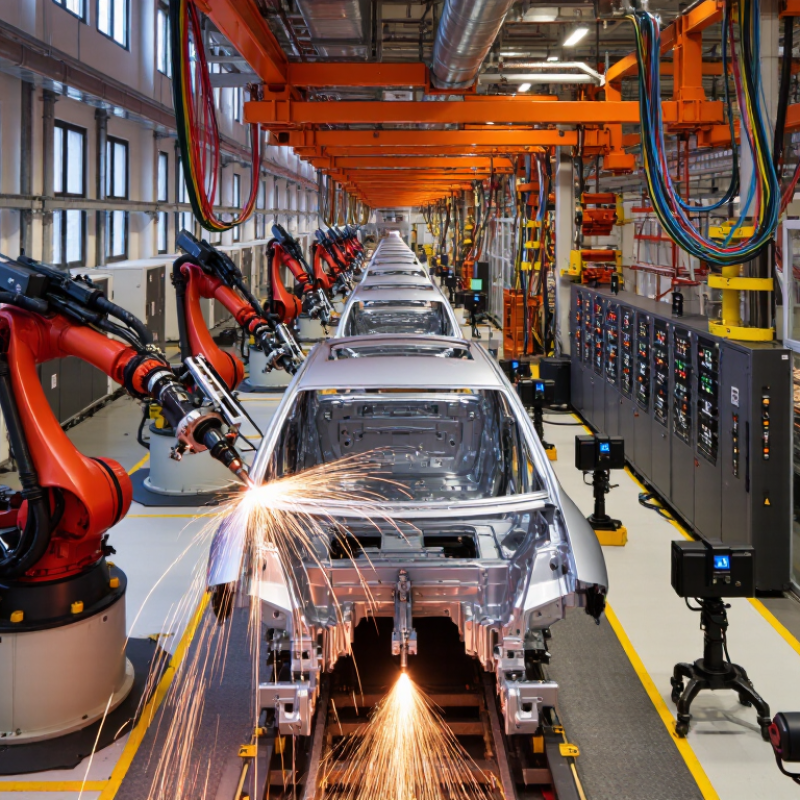
Industrial automation in Germany connects machines, software, sensors, and people across modern production. It appears in automotive plants, chemical facilities, food factories, and medium-sized engineering workshops. A robotic arm may weld a vehicle frame, while cameras inspect each seam. A programmable logic controller then records the result within milliseconds.
The German model is strongly linked with Industry 4.0. It combines industrial robots, industrial Internet of Things systems, digital twins, and real-time data. Professor Detlef Zühlke, a leading German automation expert and founder of SmartFactoryKL, described the vision as “the intelligent factory.” This idea reflects a practical goal: production should respond faster, waste less material, and support more flexible manufacturing. In this context, automation germany is not limited to robots. It also includes safety systems, predictive maintenance, process control, and secure communication between factory equipment.
Yet the picture is not perfect. High energy costs, aging machinery, skilled-worker shortages, and complex cybersecurity risks remain serious concerns. Smaller suppliers may understand automation well but lack the budget for a complete digital transformation. That gap deserves more attention. Technology alone cannot repair weak processes or unclear management decisions. Reliable results require tested equipment, trained employees, documented maintenance, and careful data protection. Germany’s industrial strength provides a strong foundation, but progress can be uneven. The most successful factories usually improve one production line at a time, measure the results, and revise their plans when reality disagrees.
Definition and Scope of Industrial Automation in Germany
Industrial automation in Germany means using control systems, software, machines, and data to perform industrial tasks with limited manual intervention. Its purpose is not simply faster production. It also supports consistent quality, safer handling, lower waste, and more predictable energy use. In a German factory, automation may begin with a sensor checking temperature or position. A controller interprets the signal. Machines or robots then respond within defined limits. People still supervise processes, adjust settings, and investigate unusual results.
The scope extends across production, logistics, maintenance, and quality management. It includes programmable controllers, industrial networks, machine vision, collaborative equipment, digital twins, and manufacturing execution software. Automated vehicles can move components between workstations. Condition monitoring can identify vibration before a motor fails. Energy systems can compare consumption across shifts. These applications appear in automotive, food processing, chemicals, pharmaceuticals, packaging, and smaller workshops. Scale differs, but the principle remains connected control.
Germany’s approach also involves documentation, functional safety, worker training, and protection of operational data. A technically impressive system can create problems if employees cannot understand its alarms. That happens. Integration between old equipment and new software is often incomplete. Cybersecurity requires regular updates, access controls, and careful network design. The human role remains practical, not decorative. Engineers test unusual conditions, operators question unexpected outputs, and managers review measurable results. Some boundaries remain unclear. Is a decision automated when a worker must approve it? That question matters in real production, where efficiency and responsibility develop together.
What Is Industrial Automation in Germany? - Definition and Scope of Industrial Automation in Germany
| Dimension | Definition or Scope | Typical German Industrial Application | Relevant Fact or Standard |
|---|---|---|---|
| Core definition | The use of control systems, sensors, software, machines and communication networks to monitor and operate industrial processes with limited direct manual intervention. | Automated production, material handling, inspection, process control, maintenance and production-data management. | Automation can cover a single machine, a production line, an entire plant or connected production sites. |
| Historical context | Germany is strongly associated with the development and promotion of the Industry 4.0 concept, which connects industrial automation with digital manufacturing. | Smart factories, connected machinery, interoperable production systems and data-driven decision-making. | The German Industry 4.0 initiative was publicly presented at the Hannover Messe in 2011. |
| Discrete manufacturing | Automation of production involving separate parts or assembled products. | Assembly, machining, welding, painting, packaging, testing and automated storage and retrieval. | Common in machinery, electrical equipment, transport equipment and metal-processing production. |
| Process industries | Continuous or batch production in which materials are transformed through physical or chemical processes. | Temperature, pressure, flow, level, mixing, dosing, reaction and quality control. | Relevant sectors include chemicals, pharmaceuticals, food processing, energy and water treatment. |
| Control architecture | A layered structure linking field devices, controllers, supervisory systems, manufacturing-management systems and business systems. | Real-time machine control connected to production planning, quality, maintenance and inventory information. | Programmable logic controllers are commonly used for deterministic machine and process control. |
| Sensors and actuators | Sensors collect physical or production data, while actuators convert control signals into movement or process changes. | Position, vibration, temperature, pressure, vision, proximity, servo motion, valves, drives and pneumatic systems. | These components form the operational foundation of automated production systems. |
| Robotics and motion control | Use of programmable machines to perform repetitive, precise, heavy or hazardous physical tasks. | Handling, palletizing, welding, assembly, machine tending, surface treatment and inspection. | Industrial robot safety is addressed by ISO 10218; collaborative robot applications are additionally covered by ISO/TS 15066. |
| Machine vision and quality | Automated capture and analysis of images or measurement data for identification, inspection and process verification. | Defect detection, dimensional checks, code reading, orientation checks and traceability. | Automation supports consistent inspection and reduces dependence on manual visual checks. |
| Industrial communication | Exchange of data between field devices, controllers, machines, supervisory platforms and enterprise systems. | Coordinated production lines, remote diagnostics, real-time monitoring and production-data integration. | OPC UA is an international interoperability framework widely used for secure industrial data exchange. |
| Data and analytics | Collection, storage and analysis of production data to improve performance, quality, maintenance and resource use. | Predictive maintenance, process optimization, energy monitoring, anomaly detection and production traceability. | Industrial analytics may use edge computing, plant-level servers or cloud platforms, depending on latency and security needs. |
| Cybersecurity | Protection of operational technology, industrial networks, control systems and production data against disruption or unauthorized access. | Network segmentation, access control, secure remote maintenance, monitoring, backups and incident response. | The IEC 62443 series provides cybersecurity principles and requirements for industrial automation and control systems. |
| Functional safety | Measures that reduce risks arising from machinery, control failures, unexpected movement and hazardous processes. | Emergency stops, protective interlocks, safety sensors, safe motion and safety-related control systems. | IEC 61508 provides a basic functional-safety framework; machinery safety also depends on applicable European requirements. |
| Regulatory framework | Industrial automation equipment placed on the German market must comply with applicable European and German legal requirements. | Risk assessment, technical documentation, conformity assessment, instructions and operating safeguards. | The EU Machinery Regulation 2023/1230 applies from 20 January 2027 and replaces the Machinery Directive framework. |
| Human–machine interaction | Interaction between operators, technicians and automated equipment through interfaces, procedures and safety systems. | Operator panels, production dashboards, guided maintenance, alarm management and collaborative workstations. | Automation generally changes job tasks and skill requirements rather than eliminating the need for human supervision entirely. |
| Sustainability and energy | Use of automation and production data to reduce energy consumption, material waste, downtime and emissions. | Energy dashboards, optimized motor control, leak detection, process efficiency and condition-based maintenance. | Energy-management practices can be aligned with ISO 50001 requirements. |
| Primary business objectives | Automation is implemented to improve operational performance while maintaining safety, quality and flexibility. | Higher equipment availability, repeatable quality, shorter changeovers, improved traceability and safer working conditions. | Common performance indicators include overall equipment effectiveness, cycle time, scrap rate, downtime and energy per unit. |
| Implementation challenges | Barriers include legacy equipment, integration complexity, cybersecurity risks, skills shortages, investment requirements and uncertain data quality. | Typical responses include phased modernization, standard interfaces, workforce training, lifecycle planning and risk-based cybersecurity. | Successful automation projects normally combine engineering, operations, information technology, cybersecurity and employee training. |
Related Posts
-
Top 10 Innovations in Automation Germany Transformed Industry?
-
Top Automation Trends in Germany for 2026?
-

What are the Best Automation Supplies for Global Procurement?
-
Top 10 Automation Supplies Every Business Needs for Efficient Operations
-
2026 Top Industrial Automation Trends You Need to Know
-
2026 Best Automation Laboratory Innovations for Enhanced Efficiency?



