
Top Manufacturing Control Systems for Global Buyers?
Choosing among manufacturing control systems is not a software shopping exercise. It is a decision about uptime, safety, data quality, and long-term operational control. Global buyers must look beyond attractive dashboards and impressive product demonstrations. A plant floor reveals the truth.
A credible system should connect sensors, programmable logic controllers, supervisory platforms, enterprise software, and human decisions. It should also support clear audit trails, role-based access, reliable backups, and secure industrial networks. Standards such as ISA-95 and IEC 62443 can provide useful evaluation references. They do not replace site-specific testing.
Shigeo Shingo, a respected manufacturing engineer, observed, “The most dangerous kind of waste is the waste we do not recognize.” His warning remains relevant. Poor integration can hide delays, repeated manual entry, energy waste, and quality drift. These losses may look small on one shift. Across several facilities, they become expensive.
No platform wins everywhere. That is the uncomfortable part. A system suited to automotive production may frustrate a food manufacturer with stricter traceability needs. Buyers should request live demonstrations using real production scenarios. They should test alarm handling, recipe changes, historian performance, and recovery after network disruption. Vendor references matter, but independent validation matters more.
This guide compares leading manufacturing control systems for global buyers. It considers scalability, interoperability, cybersecurity, implementation risk, support coverage, and total ownership cost. The strongest choice is not always the most famous one. It is the system that operators can trust during a difficult night shift.
What Manufacturing Control Systems Are and How They Operate
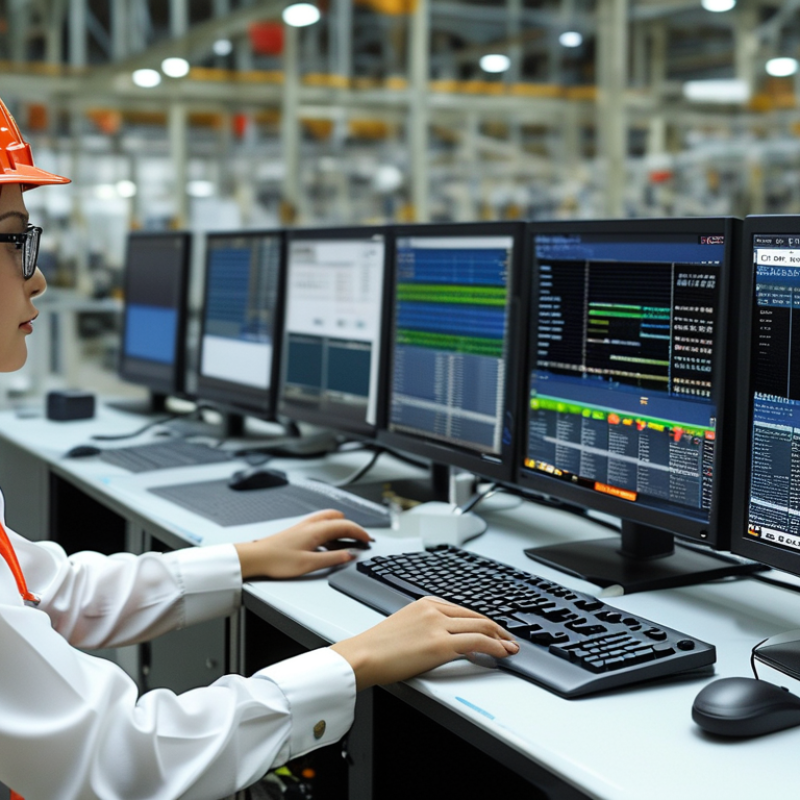
A manufacturing control system coordinates machines, materials, people, and production data. It usually combines sensors, programmable controllers, supervisory software, and production management platforms. Sensors measure temperature, pressure, speed, or position. Controllers compare these readings with programmed limits. They then adjust valves, motors, or robotic movement.
The process is continuous. A filling line detects an incorrect level, stops the pump, and alerts an operator. Supervisory control and data acquisition software displays the event in real time. Production systems can also record batch history, downtime, and quality results. Deloitte’s 2024 Smart Manufacturing and Operations Survey found that 86% of manufacturers expect smart manufacturing to become essential for competitiveness within five years. The International Federation of Robotics reported 541,302 industrial robots installed worldwide in 2023. More automated equipment increases the need for reliable control architecture.
That model sounds tidy. Factories rarely are. A sensor drifts, an old controller lacks secure connectivity, or operators override an alarm during pressure. These details create operational risk. NIST Special Publication 800-82 Rev. 3 recommends separating industrial control networks, limiting access, and monitoring unusual activity. Buyers should examine response time, data ownership, maintenance skills, and integration with existing equipment. A polished dashboard is not proof of control.现场 tests matter.
| System Type | Primary Purpose | How It Operates | Typical Control Scope | Response Characteristics | Typical Data Handled | Common Applications | Relevant Standards or Protocols |
|---|---|---|---|---|---|---|---|
| Programmable Logic Controller | Executes deterministic machine and process-control logic. | Continuously scans inputs, runs a stored control program, and updates outputs connected to sensors, actuators, drives, and safety devices. | Individual machines, production cells, packaging lines, material-handling systems, and discrete manufacturing equipment. | Typically milliseconds to tens of milliseconds, depending on the program, hardware, and network configuration. | Digital states, analog values, alarms, counters, timers, motion positions, and equipment status. | AssemblyPackagingRoboticsMachine tools | IEC 61131-3 programming languages; industrial Ethernet and fieldbus communication are commonly used. |
| Distributed Control System | Regulates continuous or batch processes across multiple process areas. | Local controllers perform closed-loop control near the equipment, while operator stations and engineering tools provide supervisory coordination and configuration. | Process plants, utilities, chemical production, food processing, pharmaceuticals, and other centralized or distributed operations. | Usually milliseconds to seconds, with control timing selected according to process dynamics and safety requirements. | Temperature, pressure, flow, level, composition, controller outputs, process alarms, and historical trends. | Continuous processingBatch processingUtilities | IEC 61511 may apply to safety instrumented functions; OPC-based interoperability and industrial field networks are common. |
| Supervisory Control and Data Acquisition | Provides centralized monitoring, supervisory commands, alarm handling, and data acquisition. | Collects information from controllers and remote devices, displays operating conditions to personnel, records events, and sends authorized supervisory commands. | Multiple machines, facilities, remote assets, water systems, energy systems, and geographically distributed operations. | Generally seconds or longer for supervisory updates; local controllers handle faster control loops. | Real-time values, alarms, events, trends, operator actions, equipment states, and selected production metrics. | Remote monitoringUtilitiesFacilitiesMulti-site operations | OPC UA, MQTT, Modbus, DNP3, IEC 60870-5-104, and other site-specific industrial protocols. |
| Manufacturing Execution System | Coordinates and tracks production activities between planning systems and shop-floor control. | Uses orders, production rules, equipment data, operator inputs, and quality requirements to manage workflows, genealogy, electronic records, and performance reporting. | Plant-wide production operations, work-in-progress, quality management, maintenance coordination, and traceability. | Usually seconds to minutes; it is not normally responsible for millisecond-level machine control. | Production orders, material genealogy, labor records, downtime, quality results, work instructions, and process history. | TraceabilityQualitySchedulingOEE reporting | ISA-95 and IEC 62264 provide widely used models for enterprise-to-control-system integration. |
| Industrial Internet of Things Platform | Connects industrial assets for data collection, analytics, remote access, and cross-site visibility. | Uses edge gateways or embedded connectivity to normalize, secure, and transmit equipment data to local or centralized applications. | Equipment fleets, distributed assets, energy monitoring, predictive maintenance, and multi-site performance analysis. | Near-real-time to minutes; time-critical control should remain in local control systems. | High-frequency sensor data, condition indicators, energy use, maintenance signals, asset metadata, and analytics results. | Predictive maintenanceEnergy managementFleet monitoring | MQTT, OPC UA, HTTPS, edge-computing frameworks, and industrial cybersecurity practices. |
| Safety Instrumented System | Reduces risk by placing equipment into a defined safe state when hazardous conditions are detected. | Monitors dedicated safety sensors, evaluates safety logic, and activates final elements independently or separately from the basic process-control system. | Critical process units, machinery safeguarding, emergency shutdown functions, and hazardous production areas. | Fast and deterministic; timing depends on the hazard analysis, safety function, and required process safety response. | Safety sensor states, trips, diagnostic status, proof-test records, bypass conditions, and shutdown events. | Emergency shutdownMachine safetyProcess protection | IEC 61508 and IEC 61511 are widely referenced for functional safety; applicable requirements depend on the industry and jurisdiction. |
| Motion Control System | Controls the position, speed, acceleration, and synchronization of mechanical axes. | Calculates motion profiles and sends coordinated commands to servo or drive systems using feedback from encoders and other position sensors. | Multi-axis machinery, robotics, converting equipment, semiconductor tools, and high-speed packaging systems. | Often sub-millisecond to milliseconds for synchronized motion, depending on the architecture and application. | Position, velocity, torque, following error, acceleration, drive status, and synchronization data. | RoboticsCNC equipmentPrintingPackaging | IEC 61800 series is relevant to adjustable-speed electrical power-drive systems; real-time industrial networks are commonly used. |
| Energy Management and Control System | Monitors, optimizes, and controls industrial energy consumption and generation. | Combines utility meters, equipment states, production information, tariffs, and operating limits to identify losses and coordinate energy use. | Electrical distribution, compressed air, steam, heating, cooling, water, renewable generation, and storage assets. | Sub-second measurements may be collected, while optimization and reporting commonly operate over seconds, minutes, or longer intervals. | Power, voltage, current, demand, power factor, fuel, water, steam, emissions, and energy intensity. | Energy monitoringLoad managementCarbon reporting | ISO 50001 supports energy-management practices; metering and communication requirements vary by facility and region. |
Related Posts
-
What Are the Top 10 Types of Manufacturing Control Systems?
-
10 Essential Automation Trends to Watch in 2026?
-

How to Leverage ASI Automation for Global Procurement Success?
-
2026 Best Industrial Automation Systems to Transform Your Business?
-

What are the Best Automation Supplies for Global Procurement?
-

Top Automation Solutions in Wisconsin You Need to Know?



