TRI-PHASEI-TECHAutomation Solutions of WI
What Are the Top Types of Lab Automation Systems?

What Are the Top Types of Lab Automation Systems?

Laboratory automation is moving from isolated instruments toward connected, data-rich workflows. Grand View Research estimates the global lab automation market reached approximately USD 5.1 billion in 2023. MarketsandMarkets projects continued growth through 2028. Their estimates differ, partly because definitions vary. Some reports include laboratory informatics. Others focus on robotic equipment.

That difference matters.

This introduction examines the top types of lab automation systems, including liquid-handling platforms, robotic workstations, total laboratory automation, automated storage, and laboratory information management systems. Each category solves a different problem. A liquid handler may transfer hundreds of samples into microplates. A robotic storage system may track thousands of tubes at controlled temperatures. A connected software layer may prevent one mislabeled barcode from affecting an entire study.

As laboratory automation consultant SiLA Foundation expert Dr. Wolfgang Hintze has noted, “Automation should support scientists, not make science less understandable.” This principle deserves attention. More automation does not automatically mean better research. Poorly validated interfaces can multiply errors faster than manual work. Incomplete staff training can create quiet failures.

The strongest systems combine precise hardware, interoperable software, clear validation records, and human oversight. They also fit the laboratory’s actual workload. A small clinical laboratory may need modular automation, not a costly fully integrated line. A pharmaceutical facility may require continuous sample tracking, robotic scheduling, and audit-ready data.

The following overview compares these systems by function, scale, flexibility, and practical value. It also considers limitations that vendors sometimes understate.
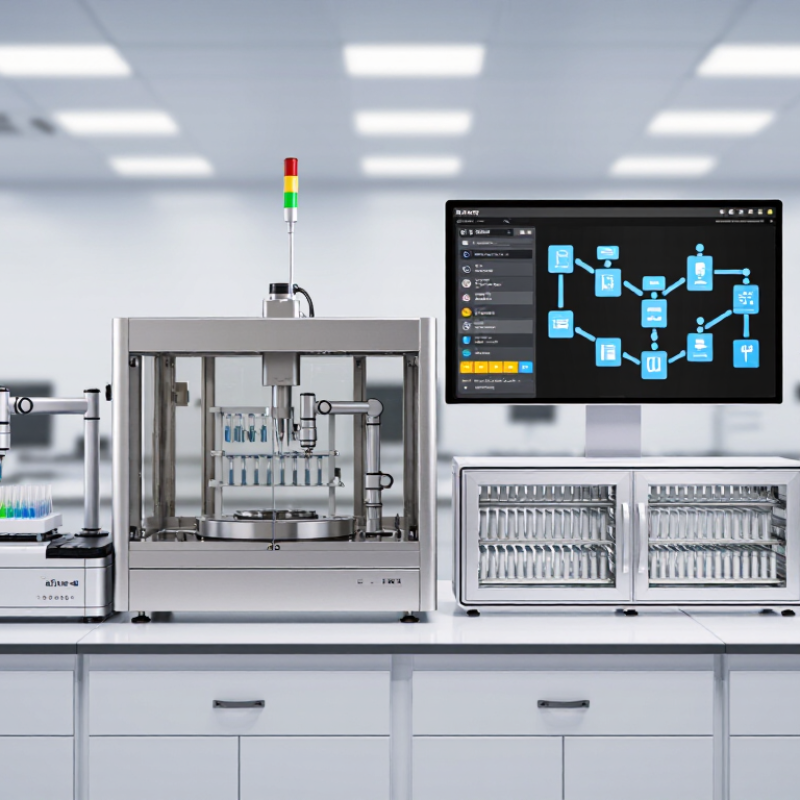
What Are the Top Types of Lab Automation Systems?

Laboratory Automation Systems: ISO 23783-1:2022 and Their Core Functions

What Are the Top Types of Lab Automation Systems?

Laboratory automation systems now cover liquid handling, sample preparation, robotic transport, and integrated workflow platforms. Their purpose is practical: move samples safely, repeat measurements, and reduce avoidable manual variation. A technician may load a plate, scan its identity, and watch a robotic arm transfer it between stations. Small details matter. A misplaced tube can disrupt an entire run.

ISO 23783-1:2022 is especially relevant because it establishes shared terms for automated liquid handling systems. Clear terminology supports better equipment selection, validation, training, and communication between laboratory teams. Core functions include dispensing, aspirating, mixing, dilution, and transferring liquids. Systems may also monitor volumes, detect errors, and record process data. These functions help laboratories manage consistent workflows, but they do not remove the need for professional judgment.

The strongest system depends on the laboratory’s workload and risk profile. A compact liquid handler may suit repetitive pipetting, while an integrated platform can connect preparation, incubation, analysis, and storage. In practice, I would examine carryover, accuracy, precision, recovery, cleaning access, and software traceability before focusing on speed. Faster is not always better. ISO terminology can improve discussions, yet the standard alone cannot prove real-world performance. Site-specific testing remains necessary. Some workflows still need manual intervention, and pretending otherwise creates weak validation plans.

Automated Liquid Handlers: 96- and 384-Well Microplate Workflows

What Are the Top Types of Lab Automation Systems?

Automated liquid handlers are central to modern 96- and 384-well workflows. They transfer samples, reagents, and controls with consistent spacing and timing. A 96-well deck suits routine assays and moderate throughput. A 384-well format reduces reagent use but exposes small errors quickly. A 1 µL variation can affect concentration, especially in miniaturized reactions. According to Grand View Research’s 2024 laboratory automation report, the global market is projected to expand steadily through 2030. This growth reflects demand for reproducibility, traceability, and higher sample capacity. ISO 8655-2:2022 also emphasizes calibrated performance for piston-operated volumetric equipment.

In practice, successful automation depends on more than robot movement. Operators should match liquid classes to viscosity, surface tension, and aspiration speed. Tip immersion depth matters. So does plate sealing, because evaporation can distort outer wells during long runs. In 384-well plates, uneven dispensing may create visible row or column patterns. That problem is easy to miss without controls placed across the plate. The Society for Laboratory Automation and Screening highlights workflow integration and data integrity as major automation priorities in its industry guidance. Still, even a well-designed method can fail after a small deck-positioning error. Human review remains necessary.

Tips: Validate with gravimetric checks and dye-based plate mapping. Compare center and edge wells. Use low-volume controls. Recheck calibration after maintenance, not only during installation. A perfect run is not proof of a perfect method.

What Are the Top Types of Lab Automation Systems?

Automated Liquid Handlers: 96- and 384-Well Microplate Workflows

Automated liquid handlers commonly work with 96- and 384-well microplates. A 96-well plate has 8 rows and 12 columns, while a 384-well plate has 16 rows and 24 columns. The 384-well format provides four times as many wells per plate, supporting higher sample density and smaller-volume workflows when the liquid handler and assay are validated for that format.

Sample-Preparation Systems: Automating Extraction, Dilution, and Aliquoting

What Are the Top Types of Lab Automation Systems?

Sample-preparation systems automate extraction, dilution, and aliquoting before analysis begins. In daily laboratory work, they reduce repetitive pipetting and improve sample traceability. A typical workflow uses barcode identification, controlled mixing, timed incubation, and disposable liquid paths. Extraction modules can process tissue, blood, or environmental samples with consistent transfer volumes. Dilution stations then create calibration or testing ranges. Aliquoting systems divide one source sample into several labeled vessels, reducing repeated freeze-thaw cycles.

The numbers support this shift. Grand View Research estimated the global laboratory automation market at approximately USD 6.4 billion in 2023, with continued growth expected through 2030. Mordor Intelligence valued the market at about USD 6.8 billion in 2024 and projects further expansion by 2029. These reports indicate growing investment, but market size alone does not prove reliable performance. Validation still matters.

Details decide outcomes. A clogged tip can distort an entire dilution series. Poor mixing can leave a visible concentration gradient. Automation is not magic. Experienced teams verify recovery, precision, carryover, and contamination control using real sample matrices. They also compare automated results with a qualified manual method during implementation. According to the Clinical and Laboratory Standards Institute’s guidance on method evaluation, documented precision and bias studies support dependable laboratory decisions. Some systems still struggle with unusual viscosity or foaming samples. That weakness deserves attention, not concealment. Human review remains necessary when signals look inconsistent, volumes fall outside tolerance, or sample quality changes unexpectedly.

Robotic Labware Handlers: SBS-Format Microplates, Tubes, and Storage

What Are the Top Types of Lab Automation Systems?

Robotic labware handlers are central to modern laboratory automation. They move SBS-format microplates, tubes, and storage racks between liquid handlers, readers, incubators, and freezers. Their value is practical: fewer manual transfers, steadier timing, and clearer sample tracking. In practice, a reliable handler needs precise grippers, barcode reading, and controlled acceleration. A slightly tilted plate can spill valuable samples.

SBS-format microplates provide a shared footprint across many instruments. This standard improves compatibility, but it does not solve every problem. Different plate heights, lids, seals, and well shapes can still cause collisions or pipetting errors. Tube handling requires similar care. Small tubes may twist, jam, or become difficult to identify. MarketsandMarkets reported that the global lab automation market was valued at about USD 5.8 billion in 2023, with continued growth expected through 2028. This trend reflects demand for throughput, traceability, and repeatable workflows. It does not guarantee a perfect system.

Tips: Test real plates and tubes before purchase. Include lids, labels, condensation, and partially filled racks. Validate barcode positions and recovery steps. Storage capacity also needs honest planning. A compact system may look efficient, yet frequent refilling can reduce productivity. Review error logs weekly. Improvement is rarely automatic.

What Are the Top Types of Lab Automation Systems? – Robotic Labware Handlers: SBS-Format Microplates, Tubes, and Storage

Labware Type Common Formats Typical Automated Tasks Handling Considerations Storage and Workflow Notes
SBS-format microplates 96-, 384-, and 1536-well plates; standard SBS footprint is approximately 127.76 × 85.48 mm. Plate transport, barcode reading, deck positioning, liquid-handling steps, and transfers to readers or washers. Confirm plate height, lid type, skirt style, gripping surfaces, and well layout. Compatibility depends on the handler and its gripper or plate nest. Can be staged in stackers or hotel modules. Temperature-controlled storage may be needed for temperature-sensitive assays.
Microplate lids and seals Plate-specific lids, breathable seals, and adhesive or heat seals. Lid placement and removal, seal application, and movement between covered and uncovered workflows. Match the lid or seal to the plate geometry and assay requirements. Confirm that grippers can handle the selected cover without shifting it. Covering plates can help reduce evaporation or contamination risk, but sealing requirements vary by application.
Sample tubes Common small-volume formats include 0.5 mL, 1.5 mL, and 2.0 mL tubes; available sizes and geometries vary. Tube picking, barcode identification, sorting, rack loading, and transfer to processing stations. Tube diameter, cap shape, cap tightness, and rack position affect reliable pickup and identification. Use compatible racks and validated handling settings. Racks can support organized transport and storage. Required temperature depends on the sample and protocol.
Tube racks and SBS-format carriers Racks arranged for a defined number of tubes; some carriers use an SBS-compatible footprint. Batch movement, tube presentation, sample tracking, and transfers between workstations. Verify rack dimensions, well spacing, tube orientation, and barcode visibility. A standard footprint does not guarantee compatibility with every instrument. Carriers can connect tube workflows with plate-oriented automation when the equipment supports the rack geometry.
Plate and tube storage modules Stackers, hotel-style storage, ambient enclosures, and temperature-controlled units. Buffering labware between process steps, staging batches, and retrieving items in a defined sequence. Check capacity, access direction, labware dimensions, lid clearance, and recovery behavior after an interruption. Storage conditions may be ambient, refrigerated, or frozen depending on the module and sample requirements; confirm actual operating specifications.
Mixed-labware workflows Combinations of plates, tubes, racks, lids, and adapters. Moving samples across dispensing, incubation, reading, and storage steps. Use validated deck layouts, labware definitions, barcode rules, and transfer positions. Adapters may be needed when formats differ. Plan for traceability, collision-free routes, and recovery procedures before running unattended workflows.

Compatibility, capacity, and environmental limits vary by system and labware. Confirm dimensions and operating specifications with the relevant equipment documentation before implementation.

Integrated Automation Workcells: Connecting Instruments, Robotics, and LIMS

Integrated Automation Workcells: Connecting Instruments, Robotics, and LIMS

An integrated workcell links instruments, robotic handling, and a laboratory information management system (LIMS) into one coordinated workflow. A robot can move a barcoded sample from a decapper to a liquid handler, while the LIMS records each transfer and instrument result. That connection reduces manual transcription and makes sample status easier to trace.

Small details bite. A mismatched identifier or an unclear exception rule can still interrupt the run.

MarketsandMarkets estimated the global laboratory automation market at $5.4 billion in 2023, with a forecast of $8.1 billion by 2028. This market estimate signals growing investment, but it does not guarantee that every workcell will deliver the same returns. Practical results depend on throughput, assay variability, and how reliably instruments share data.

Not always. A fast robot cannot fix a poorly defined workflow.

Good integration starts with mapping real sample journeys, including holds, repeats, and failed runs. Teams should test instrument interfaces, barcode readability, and LIMS data fields using representative samples before routine deployment.

They should also define who handles exceptions and how changes are documented. This can feel slow. Yet a few deliberate test runs often reveal handoff problems that a polished equipment demonstration may miss.